

The best training plan in the world is useless if it falls apart by Wednesday. Most athletes don’t struggle because they lack motivation or knowledge. They struggle because their week has no shape. Sessions get shuffled, hard workouts land back-to-back, rest days vanish, and by the end of the month, fitness has stalled while fatigue keeps climbing.
A well-built weekly training schedule fixes that. It turns good intentions into a repeatable rhythm, one that balances hard work with recovery and fits around the rest of your life. Whether you’re a runner, cyclist, triathlete, or field-sport athlete, the principles are the same, and once you understand them, you can build a week that holds up in January and still works in July.
Why Structure Beats Motivation
Motivation is unreliable. It peaks on the first of the month and fades with the first cold, dark morning. Structure doesn’t depend on how you feel. When you already know that Tuesday is intervals, Wednesday is easy, and Friday is rest, there’s no daily negotiation with yourself. The decision was made once, in advance.
A structured week also protects your body. Training is a cycle of stress and adaptation: you apply a load, recover, and come back slightly stronger. When hard sessions are spaced well, each one lands on a recovered body. When they’re crammed together, you accumulate fatigue without the adaptation that makes it worthwhile.
Finally, structure makes progress measurable. If your week looks roughly the same from one to the next, you can see what’s working, what’s slipping, and what needs to change.
The Building Blocks of a Balanced Training Week
Before you place anything on a calendar, it helps to know what goes into it. Almost every effective weekly training schedule is built from five ingredients.
Key sessions are the workouts that drive specific fitness gains: intervals, tempo efforts, long sessions, or high-quality skills practice. Most athletes need only two or three per week. These get the best time slots and the freshest legs.
Easy aerobic sessions make up the bulk of training volume for most endurance athletes. They build your engine, aid recovery, and should genuinely feel easy. Many successful endurance programs keep the large majority of training time at low intensity, with a smaller share reserved for hard work.
Strength training supports performance and reduces injury risk. Two sessions per week is a solid target for most athletes, often paired with a hard day rather than an easy one.
Rest and recovery includes full rest days and very light movement. This is where adaptation actually happens, so it belongs on the schedule, not in the gaps.
Mobility and maintenance covers short routines for flexibility, activation, and injury prevention. These are small, frequent, and easy to attach to other sessions.
How to Build Your Weekly Training Schedule, Step by Step
Step 1: Map Your Fixed Commitments First

Start with what can’t move: work hours, school, family responsibilities, commute times, and regular obligations. Block these on a blank weekly calendar before you add a single workout. This shows you your real available training windows rather than the ones you wish you had.
Be honest. If mornings before work are realistically 45 minutes, don’t schedule 90-minute sessions there. A plan built around your actual life is one you’ll follow.
Step 2: Place Your Key Sessions
Next, place your two or three most important workouts. Give them your best windows, when you have the most time, energy, and focus. For many people with a standard work week, that means a midweek quality session and a longer session on the weekend.
The golden rule is spacing. Aim for roughly 48 hours between hard sessions so you arrive at each one recovered enough to perform well. Two hard days in a row usually means the second one is compromised.
Step 3: Fill in Easy Days Around Them

Easy sessions go on the days surrounding your key workouts. They keep your aerobic system developing while giving your body room to absorb hard training. The hard-easy pattern is one of the simplest and most reliable principles in athletic training.
The biggest mistake here is letting easy days drift into moderate territory. If you finish an easy session feeling like you worked hard, you went too fast. Keep them conversational.
Step 4: Slot in Strength Training
Schedule two strength sessions per week. A common and effective approach is to pair strength with a hard day, either later the same day or directly after the key session, so that your easy days stay truly easy and your recovery days stay intact. Keep at least one full day between strength sessions.
If you’re new to lifting, start conservatively. Heavy leg work the day before a key workout will undermine that workout.
Step 5: Protect at Least One Rest Day

Put your rest day on the calendar and treat it like any other appointment. Most athletes benefit from one full rest day per week, often after the hardest or longest session. Resting isn’t a lapse in discipline. It’s part of the plan.
If you find yourself repeatedly skipping rest days to “make up” for missed sessions, that’s a sign your schedule is overloaded, not that you need more willpower.
Step 6: Build a Minimum Viable Week
Life will interrupt your plan. Illness, deadlines, travel, and family events are inevitable. Decide in advance what your stripped-down week looks like: typically your two most important sessions plus one short easy session. When things get chaotic, you drop to this version instead of dropping everything.
This one habit protects consistency more than any other. A reduced week still counts. A skipped week breaks momentum.
Sample Weekly Training Schedule
Here’s an example for an endurance athlete with a standard Monday-to-Friday job, training around six to eight hours per week.
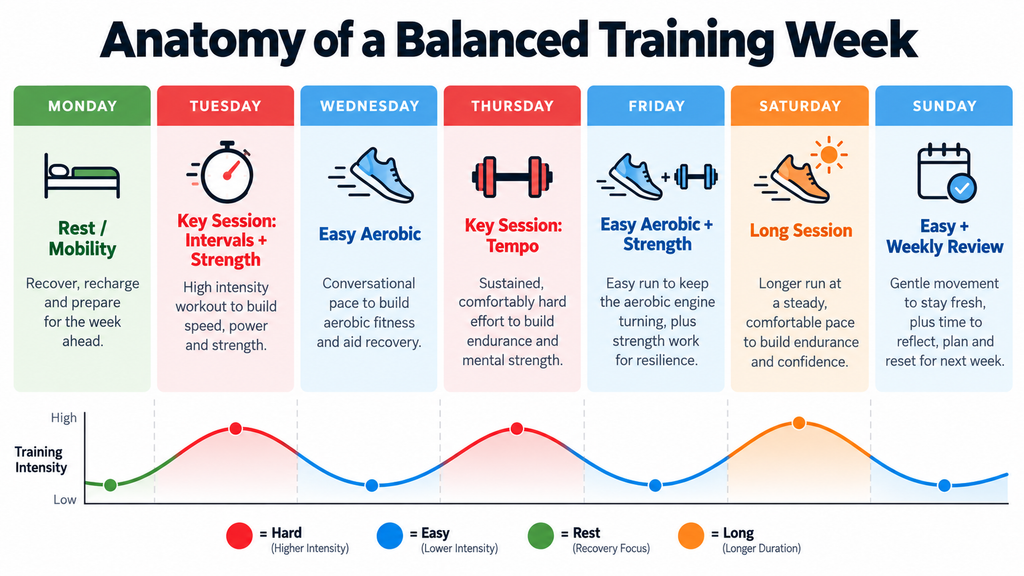
Notice the pattern: hard days are separated by easy days, strength sits on days that are already demanding or low-risk, and the week opens with recovery after the weekend’s load.
Adapting the Schedule for Team and Field Sport Athletes
If you play a team sport, your week revolves around fixed team practices and match day. Treat match day as your biggest key session and build backward from it. The day before a match should be light, focused on activation and skills. The day after should prioritize recovery. Place your heaviest strength work early in the week, when it has the most time to clear before competition, and keep conditioning away from the 48 hours before a match.
Common Weekly Scheduling Mistakes
The most frequent problem is stacking hard days. Doing intervals Tuesday, a hard group ride Wednesday, and tempo Thursday leaves you tired and underperforming in all three.
Another is making every day moderate. Without truly easy days, you never fully recover, and without truly hard days, you never push your fitness forward. The middle ground feels productive but often delivers the least.
Overplanning is a subtler mistake. A schedule with no breathing room collapses at the first disruption. Leave some slack.
Finally, many athletes change their plan constantly. Give a weekly structure at least three to four weeks before judging it. Adaptation takes time to show up.
How to Make Your Schedule Stick
Train at the same time on the same days whenever possible. Routine reduces friction, and after a few weeks the session becomes automatic rather than a choice.
Hold a 15-minute weekly review every Sunday. Look back at what you completed, note how you felt, and adjust the coming week for known commitments. This is also the perfect moment to plan meals for the week ahead (our upcoming guide to meal prep for busy athletes covers a simple Sunday system).
Prepare the night before. Lay out kit, pack your bag, and set up your fueling. Removing morning decisions removes morning excuses.
And don’t neglect sleep. Your schedule is only as effective as your recovery, which is why we’ll be covering sleep as a performance enhancer next week.
Frequently Asked Questions
How many days a week should an athlete train?
Most amateur athletes do well training five to six days per week, with at least one full rest day. Beginners may start with three or four days and build gradually.
How many hard workouts should be in a weekly training schedule?
Two to three key sessions per week is enough for most athletes. More than that often increases fatigue faster than it improves fitness.
Should I do strength training on easy days or hard days?
Pairing strength with hard days usually works best, because it keeps easy days genuinely easy and concentrates stress so recovery days stay restful.
What should I do if I miss a workout?
Usually, just move on. Don’t cram the missed session into the next day. If it was a key workout, you can sometimes swap it with an upcoming easy day, as long as you keep hard days spaced apart.
The Bottom Line
Consistency isn’t about heroic weeks. It’s about ordinary weeks, repeated over and over. A thoughtful weekly training schedule, built around your real life, with key sessions spaced apart, easy days kept easy, strength scheduled with purpose, and rest protected, gives you a rhythm you can sustain for months. Build your week once, review it every Sunday, and let the structure carry you through the days when motivation doesn’t show up.