
Every athlete has stood on a start line and felt it: the quiet voice asking, Am I actually ready for this? Some people seem immune to that voice. They walk into big moments looking relaxed, certain, almost bored. It’s tempting to believe they were simply born that way.
They weren’t. The confidence you see in top performers is mostly the visible tip of a huge pile of evidence they’ve collected, often without realizing it. The good news is that you can build that pile on purpose. In this post, you’ll learn how to build confidence as an athlete using two simple tools: an evidence journal and a deliberate focus on small wins.
Why Confidence Is a Skill, Not a Personality Trait
Sports psychologists often draw on the work of psychologist Albert Bandura, whose research on self-efficacy (your belief that you can succeed at a specific task) identified several sources of that belief. The most powerful is what he called mastery experiences: things you’ve actually done yourself.
Encouragement from a coach helps. Watching a teammate succeed helps. Feeling physically good on the day helps. But nothing convinces your brain quite like proof that you have already done hard things.
That changes how we should think about athlete confidence. It isn’t a mood you summon on race morning, and it isn’t a trait you either have or lack. It’s a conclusion your mind reaches based on evidence. If the evidence is thin, forgotten, or buried under memories of mistakes, your confidence will be fragile. If the evidence is abundant and easy to recall, your confidence gets sturdier.
There’s a catch, though. Human memory has a negativity bias. We tend to remember the missed shot, the blown split, and the session we cut short far more vividly than the hundreds of sessions that went fine. Left alone, your memory builds a lopsided case against you.
An evidence journal corrects that imbalance.
What Is an Evidence Journal?
An evidence journal is a written record of proof that you are capable, prepared, and improving. It isn’t a training log full of numbers, and it isn’t a feelings diary. It’s closer to a legal case file, with you as the defense attorney collecting exhibits.
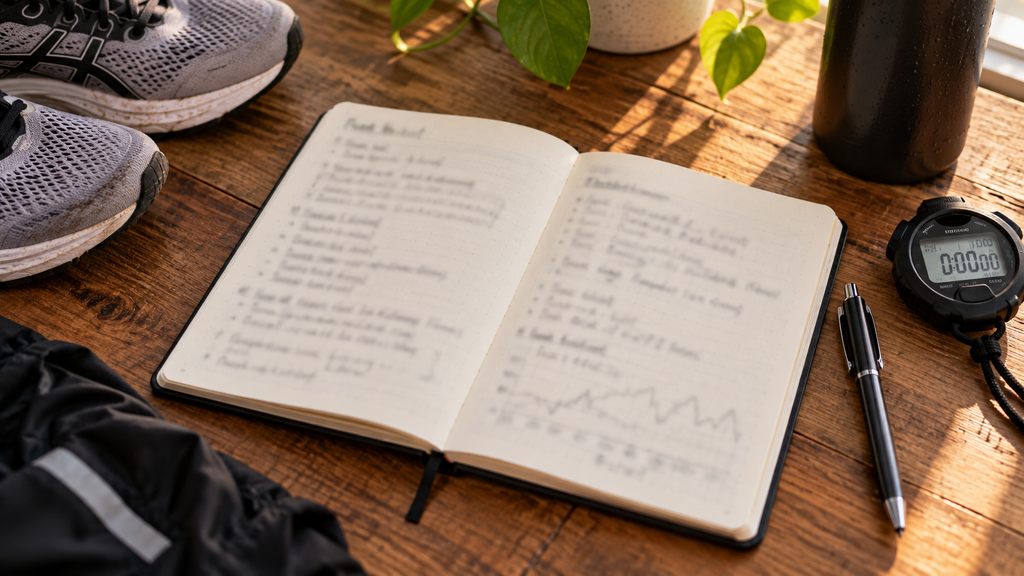
Each entry answers one simple question: What did I do today that proves I’m getting better or that I can handle what’s coming?
The entries can be big (“Held goal pace for the full 20 minutes”) or tiny (“Went out the door even though it was raining and I didn’t want to”). Both count. In fact, the tiny ones often matter more, because they show the consistency and resilience that pressure situations demand.
What counts as evidence
Useful evidence usually falls into a few categories:
- Performance evidence: a time, weight, distance, score, or skill you hit.
- Process evidence: you executed the plan, such as the warm-up, the fueling, or the pacing, whatever the result.
- Resilience evidence: you kept going, recovered from a mistake, or adjusted when things went wrong.
- Consistency evidence: you showed up, completed the week, or protected your sleep.
- Feedback evidence: a coach, teammate, or data point confirmed progress.
Notice that only one of those categories depends on the outcome. That’s intentional. Confidence built only on results collapses the first time results dip. Confidence built on process and resilience holds up much better.
The Power of Small Wins
If the evidence journal is the filing cabinet, small wins are what you put inside it.
A small win is a clearly defined, achievable target that you can complete in a single session or day. It’s small enough that you’ll usually succeed, but meaningful enough that success actually says something about you.
Research on motivation in the workplace, most notably Teresa Amabile’s work on the “progress principle,” found that making progress on meaningful work was one of the strongest boosters of motivation and emotional state on a given day. Athletes experience the same effect. Progress you can see fuels effort, and effort creates more progress.

How to design small wins in training
Big goals are important for direction, but they’re terrible for daily confidence because you rarely get to check them off. Small wins close that gap. Here’s how to set them:
- Make them specific. “Train well” is not a small win. “Hit all six intervals within two seconds of target” is.
- Make them mostly controllable. Favor process targets (technique cues, effort, execution) over outcomes you can’t fully control.
- Set the bar at “likely, but not guaranteed.” If you succeed every single time, raise it slightly. If you fail more often than you succeed, lower it.
- Attach one to every session. Even an easy recovery day can have a small win, such as “kept heart rate in zone 1 the whole time.”
- Write it down before the session. Declaring the target in advance makes completing it feel earned instead of lucky.
If you’ve read our post on process goals vs. outcome goals, you’ll recognize this approach. Small wins are process goals shrunk down to a single day.
How to Start Your Evidence Journal: A Simple Weekly System
You don’t need a fancy app or a beautiful notebook. You need a system simple enough that you’ll still be using it in six weeks. Here’s one that takes about five minutes a day.
Daily (2–3 minutes after training)
Write three short lines:
- Today’s small win: Did I hit it? Yes/No.
- One piece of evidence: What did I do today that proves I’m capable?
- One thing I handled: What was hard, and how did I respond?
Keep it brief. A sentence per line is plenty. The goal is volume and consistency, not literary quality.
Weekly (10 minutes, same day each week)
Read back through the week’s entries and answer:
- What is the strongest piece of evidence from this week?
- What pattern do I notice in what’s going well?
- What is next week’s slightly harder small win?
Many athletes like to do this on Sunday, alongside meal prep and planning the week ahead.
Before competition (5–10 minutes)
This is where the evidence journal pays off. In the days before a big event, and again on race morning if it helps you, read back through your entries. You aren’t hyping yourself up with empty affirmations. You’re reviewing the facts.

When the voice asks Am I ready for this?, you can answer with specifics: “I’ve held this pace in training four times. I finished the session in the storm. I recovered from a bad start in March and still hit my target.” That’s confidence built on proof, and it’s much harder for nerves to argue with.
The Confidence Loop: How It All Fits Together
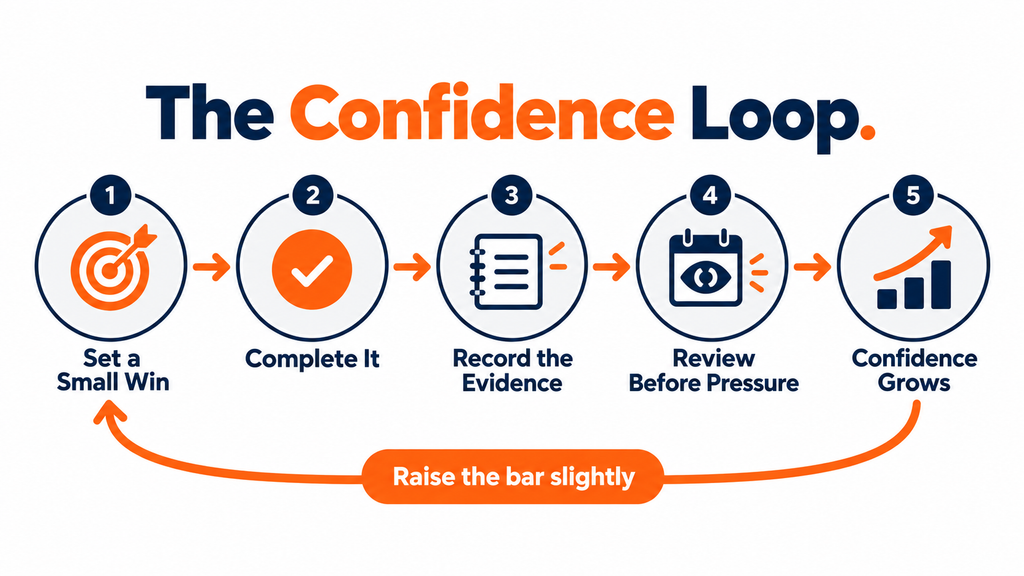
Small wins and evidence journals work best as a cycle that feeds itself:
[INFOGRAPHIC — place here, directly under this heading]
- Set a small win before the session.
- Complete it (or learn from falling short).
- Record the evidence in your journal.
- Review the evidence weekly and before pressure moments.
- Confidence grows, which makes you willing to set a slightly bigger small win.
Every trip around the loop adds weight to your case file. After a few months, you’ll have dozens or even hundreds of entries, and your belief in yourself will rest on a foundation you built by hand.
Common Mistakes (and How to Avoid Them)
Only recording big results. If you wait for PRs to write something down, your journal will be nearly empty and your confidence will swing with every result. Record process and resilience wins too.
Making small wins too ambitious. A small win you miss four days out of five erodes confidence instead of building it. Scale it down until success is the norm.
Turning it into a criticism log. It’s healthy to note what went wrong, but that belongs in your training log or your post-race review. The evidence journal is specifically for proof of capability. Keep it that way.
Skipping the review. Writing entries helps, but reading them back is where the real benefit shows up. Put your weekly review on the calendar.
Comparing your evidence to someone else’s. Your journal measures you against your past self, not against the athlete with the highlight reel on social media. (More on that in our upcoming post on handling comparison and social media.)
What About Bad Days?
Bad days are inevitable, and they belong in the process too. On a rough day, look for the resilience evidence: I was exhausted and I still finished the warm-up. I missed the first rep and adjusted my pacing for the rest. Those entries become some of the most valuable in the journal, because competition rarely goes perfectly. Knowing you’ve handled things going wrong before is exactly what helps when it happens again.
If a bad day turns into a bad race, pair this practice with a structured debrief. That separates what happened from what it means about you.
Start Today: Your First Entry
You don’t need to wait for a new training block or a fresh notebook. Tonight, write down:
- One thing you did in training this week that you’re proud of.
- One hard moment you handled.
- Tomorrow’s small win.
That’s your first piece of evidence. Confidence is built one entry at a time, and you’ve just laid the first brick.