
Self-Talk: How to Coach Yourself Through Hard Sessions
The hardest moment in any session isn’t physical. It’s the quiet second when your legs are burning, the next rep looks impossible, and a voice in your head says you can’t. What you say back in that moment often decides whether you finish strong or fold early.
That inner voice is self-talk, and it’s trainable. Self-talk for athletes is one of the most studied and practical tools in sport psychology. It costs nothing, needs no equipment, and goes with you into every interval, lift and race. This guide explains how it works, the two types worth using, and a five-step plan to build your own inner coach.
What is self-talk?
Self-talk is the running commentary you have with yourself, out loud or in your head. Every athlete has it. The question is whether it’s helping or hurting.
Sport psychologists split it into three broad kinds:
- Negative self-talk — critical or catastrophic: “I’m so slow,” “I always fade,” “This is going to hurt.”
- Positive self-talk — encouraging and supportive: “You’ve done this before,” “Keep going.”
- Neutral or instructional self-talk — focused on what to do: “Drive the knees,” “Long exhale,” “Quick hands.”
Negative thoughts aren’t a sign of weakness. They’re a normal response to discomfort. The skill isn’t banning them. It’s noticing them quickly and replacing them with something useful.
Why self-talk for athletes changes performance
Your perception of effort isn’t fixed. How hard a session feels depends partly on what you tell yourself about it. Studies of endurance athletes have found that training motivational self-talk can lower perceived exertion and extend how long people can sustain a hard effort.
There are three reasons it works:
- It directs attention. Instructional cues pull your focus back to technique instead of discomfort.
- It regulates arousal. The right words can calm you when you’re too wound up or lift you when you’re flat.
- It builds belief. Repeated, credible statements reinforce confidence that you can handle the work.

Visualization and Mental Rehearsal: A Step-by-Step Practice
The two types of self-talk that matter: instructional vs motivational
Not all positive self-talk is equal. Match the type to the task.
| Type | What it does | Best for | Examples |
|---|---|---|---|
| Instructional | Directs technique and focus | Skill, precision, form under fatigue | “Tall hips,” “Smooth catch,” “Eyes up” |
| Motivational | Builds effort, energy and confidence | Endurance, strength, grinding through pain | “Stay strong,” “One more,” “You own this” |
A useful rule: when technique is breaking down, use instructional cues. When willpower is breaking down, use motivational ones. Many athletes use both in the same session — instruction early in a set, motivation in the final reps.
First person or second person?
How you address yourself matters too. Research on “distanced” self-talk suggests that speaking to yourself as you or by your own name (“Come on, Sam, hold this pace”) can feel more like coaching and less like panicking. It creates a little psychological distance, as if a coach were beside you.
Try both in training and keep whichever feels more natural under pressure.
How to coach yourself through hard sessions: a 5-step plan
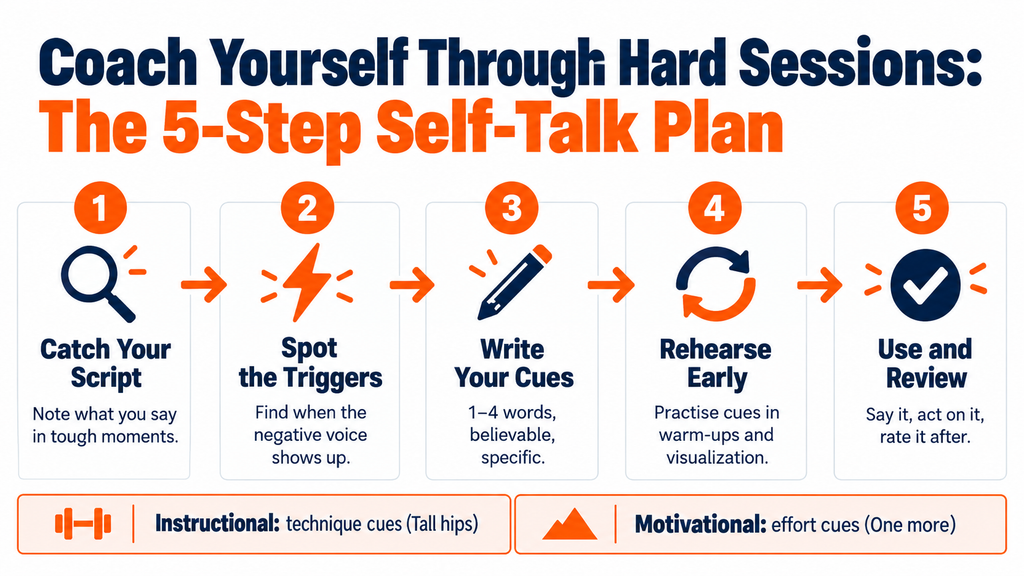
Step 1: Catch your current script
For one week, notice what you say to yourself during hard sessions. Right after each session, write down two or three phrases that came up, especially at the toughest moments. Don’t judge them; just collect them. Most athletes find their negative self-talk is repetitive — the same few lines on a loop.
Step 2: Spot the trigger points
Look for patterns. When does the negative voice show up? Common triggers include:
- The midpoint of an interval set, when the end feels far away
- The first sign of a missed split or target
- Comparing yourself to a training partner
- Fatigue late in a long session
Knowing when the voice appears lets you prepare a response in advance.
Step 3: Write your replacement cues
For each trigger, write a short replacement. Keep cues to one to four words: long sentences are hard to recall when you’re breathing hard.
| Negative thought | Replacement cue | Type |
|---|---|---|
| “I can’t hold this pace.” | “Relax the shoulders.” | Instructional |
| “I always fade at the end.” | “Finish the rep.” | Motivational |
| “Everyone’s faster than me.” | “My race, my pace.” | Motivational |
| “This hurts too much.” | “Strong and smooth.” | Mixed |
The best cues are believable. “I feel amazing” during the eighth 400 m repeat won’t land. “I can do one more” will.

Step 4: Rehearse before you need it
Cues work best when they’re automatic. Practise them before the session so you don’t have to invent them mid-effort:
- Write your two or three key cues on tape on your bike stem, water bottle or wrist.
- Say them during warm-ups so they’re the first words that come to mind.
- Pair them with visualization: picture the hard moment, then hear yourself say the cue (see our upcoming guide to visualization and mental rehearsal).
Step 5: Use it in the hard moment, then review
When the trigger hits, use the cue: say it, then act on it. If you can, say it out loud — even a whisper makes it harder to ignore. After the session, rate how well your cues worked from 1 to 5 and swap out anything that felt flat. Treat your self-talk like any other part of your training: test, review, adjust.
Self-talk mistakes to avoid
- Fake positivity. If you don’t believe the words, your brain won’t either. Choose honest, achievable statements.
- Cues that are too long. Under load, short beats clever.
- Waiting until race day. Self-talk is a skill. Train it in workouts first.
- Arguing with every thought. You don’t need to win a debate with your doubts. Acknowledge them (“That’s the fatigue talking”) and redirect.
- Only using it when things go wrong. Reinforce good moments too: “That’s the form,” “Good decision.”

Putting it together
You already talk to yourself through every hard session. Self-talk training just makes sure the voice is on your side. Start this week: catch your script, find your triggers, write three short cues and rehearse them before your next tough workout.
Over time, that inner voice becomes the coach you carry everywhere — calm when you need focus, fierce when you need effort. Next week in our mental-skills series, we’ll pair these cues with visualization so you can rehearse hard moments before they happen.