
You finish a solid session. You hit your splits, your legs feel good, and you’re quietly pleased. Then you open your phone. A training partner has posted a faster time. A rival is sharing photos from an altitude camp. Someone you’ve never met has logged twice your weekly volume. Ten minutes later, a good day feels like a failing one.
If that sounds familiar, you’re not alone. The relationship between athletes and social media has become one of the most underrated pressures in modern sport. Feeds give you a constant, curated look at everyone else’s best moments, and your brain treats each one as a benchmark.
Comparison isn’t going away, and quitting every app isn’t realistic for most athletes. But you can change how comparison affects you. This guide explains why it hits athletes so hard, how it quietly damages performance, and seven practical ways to keep your focus where it belongs: on your own process.
Why comparison hits athletes so hard
Athletes are trained to compare. Results, rankings, selection and personal bests are all measured against other people or against past versions of yourself. That habit is useful on race day. It becomes a problem when it runs all day, every day, through a screen.
Three things make social media comparison especially sharp for athletes:
- You only see the highlight reel. People post the PB, not the 14 sessions that went badly before it. You compare your full training log with their best 2%.
- The numbers look objective. Pace, power, watts per kilo and lifting totals feel like hard facts. But they leave out age, training history, terrain, recovery, injury status and how honestly they were recorded.
- Your identity is tied to performance. When sport is a big part of who you are, someone else’s progress can feel like a verdict on your worth, not just a data point.
Add fitness-tracking apps like Strava, where every run and ride sits in a public feed with segment leaderboards, and comparison becomes part of training itself.
How comparison quietly hurts your performance
Comparison rarely feels dramatic. It shows up as small decisions that add up over weeks.
- Abandoning your plan. You see someone’s big session and add an extra one of your own. Your coach’s carefully built progression gets overridden by a stranger’s post.
- Turning easy days into hard days. Easy runs and recovery rides look slow in public. Many athletes push them faster to protect how their uploads look, which undermines the base training that makes them fast.
- Racing the feed, not the event. Outcome anxiety rises when you know who’s watching and what they’ve posted. Your attention shifts from execution to impression management.
- Eroding confidence. Every comparison you lose chips away at belief. Over time, you go into competition with a mental record of being “behind”, even when your own data says you’re improving.
- Poorer sleep and recovery. Late-night scrolling delays sleep, and an anxious mind recovers less well. For more on this, see our post on sleep as a performance enhancer.
Social media and athlete mental health are closely linked. If comparison is leaving you persistently low, anxious or questioning whether you belong in your sport, that’s worth raising with a coach, sport psychologist or GP, not just pushing through.
7 ways to handle comparison and social media
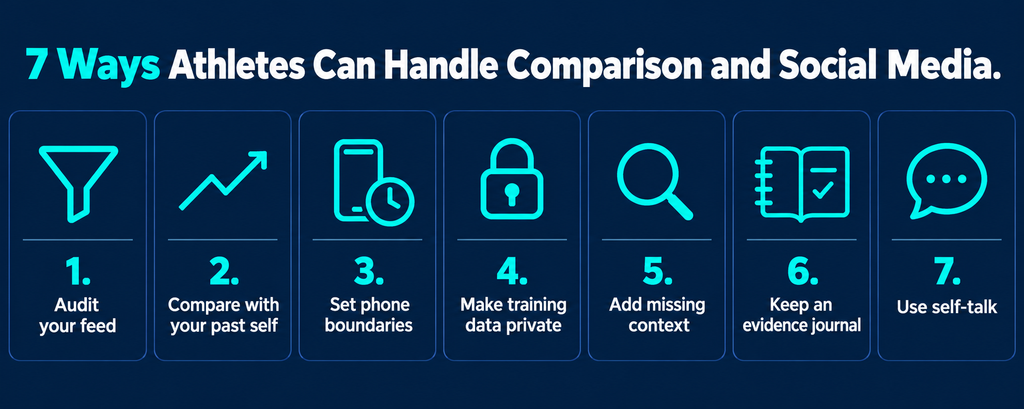
1. Audit your feed
Scroll through your feeds and notice how each account makes you feel. Does it teach you something, inspire you, or leave you feeling behind? Mute or unfollow anything that reliably triggers the last one. You don’t owe anyone a follow, including rivals and teammates. Muting is invisible and reversible.
2. Compare with your past self, not other people
The only fair comparison is you against you: same body, same history, same life demands. Keep a simple log of benchmark sessions, such as a monthly time trial or a key lift, and review it every 4–6 weeks. Seeing your own trend line is far more motivating than someone else’s highlight.
3. Set clear phone boundaries around training
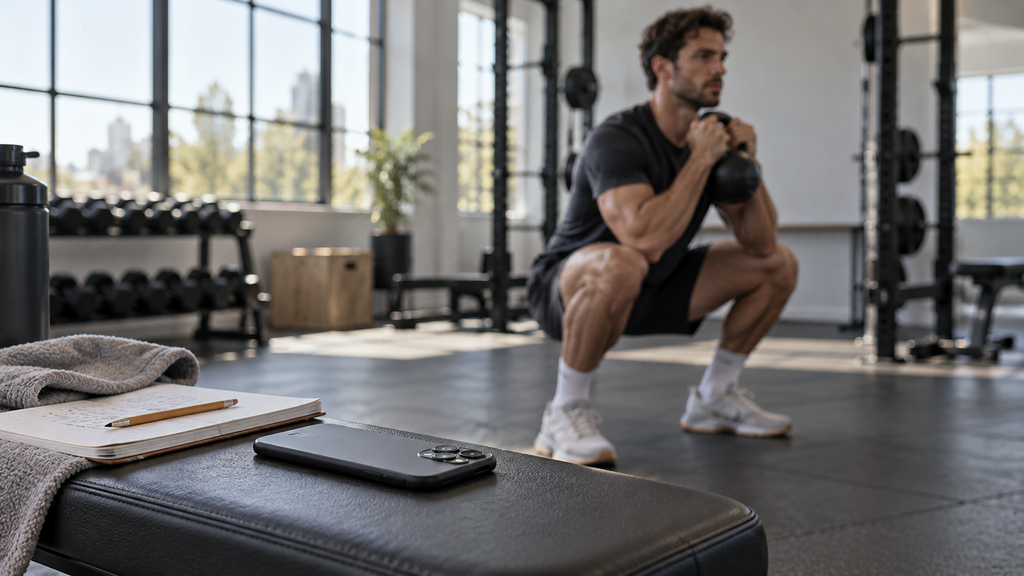
Decide when your phone is and isn’t part of your sport. Practical rules many athletes use:
- No scrolling for 60 minutes before a key session or competition
- No posting or checking reactions until you’ve eaten and cooled down
- Phone out of the bedroom, or on do-not-disturb, an hour before sleep
- One fixed window a day for social apps instead of constant checking
4. Make your training data private
Most fitness apps let you hide activities, set them to followers only, or hide specific data such as pace and heart rate. Making easy days private removes the temptation to run them too fast for an audience. Share what you want to share, not everything by default.
5. Add context you can’t see
When a post stings, deliberately list what you don’t know. What’s their training age? Are they full-time? Were they on a downhill course, in a pack, or tapered? Is it even accurate? You’ll rarely have the answers, and that’s the point: the comparison was never fair to begin with.
6. Build an evidence journal
Confidence comes from proof. Keep a short note each week of three things you did well: a session you completed, a skill you sharpened, a hard day you showed up for. Before competitions, read it back. It gives your brain your own evidence to weigh against what the feed shows. Our post on confidence and evidence journals walks through this in detail.
7. Use self-talk to interrupt the spiral
When you catch yourself comparing, name it and redirect it. A simple script works: “That’s their journey. What’s my next job?” Then answer it with something concrete, like stretching, eating or prepping tomorrow’s kit. Turning comparison into a process cue keeps it from becoming a story about your worth.
Using social media on your own terms
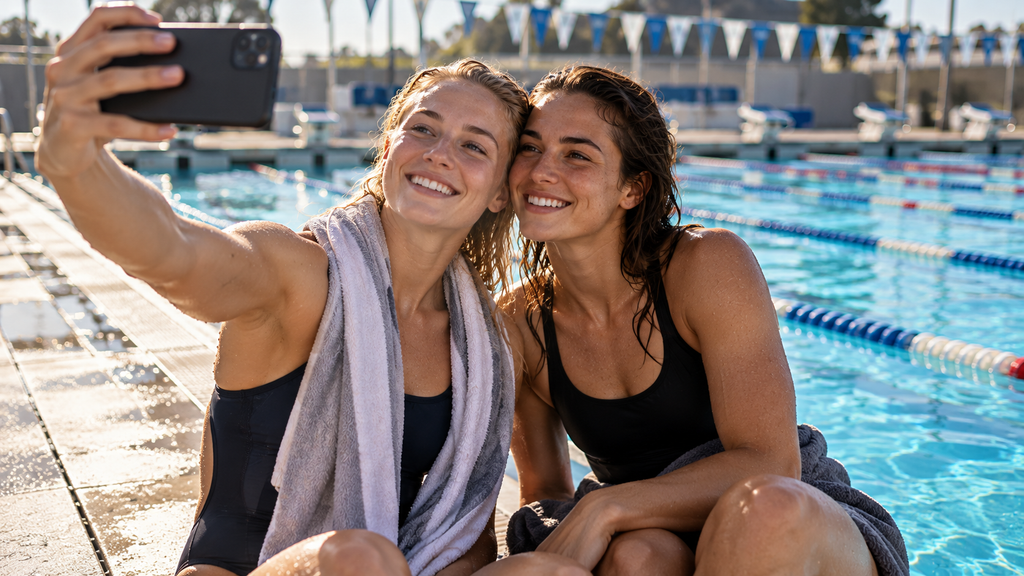
Social media isn’t all bad for athletes. It can connect you with training partners, sponsors, coaches and a community that gets what you do. The difference is whether you’re using it deliberately or it’s using you.
If you post, decide why. Sharing your process, documenting your season or building a following for sponsorship are all valid. Then post with that purpose in mind, rather than reacting to what others are doing. Some athletes find it helps to schedule posts after the fact, so competition day stays about competing.
And if a stretch of the season calls for it, take a full break. A social media detox around a championship, a comeback from injury or a rough patch is a performance decision, not a weakness.
Frequently asked questions
Is social media bad for athletes?
Not inherently. It can build community, support sponsorship and share useful knowledge. It becomes harmful when it drives constant comparison, disrupts sleep or pulls you away from your training plan. The goal is deliberate use, not zero use.
How do I stop comparing myself to other athletes?
You probably won’t stop completely, and that’s fine. Reduce the triggers by auditing your feed and setting phone boundaries. Then redirect comparison toward your own past results and use a short self-talk cue to bring your focus back to your next task.
Should I make my Strava private?
If public uploads tempt you to run easy days too fast or leave you anxious after hard sessions, yes. You can hide individual activities or specific data like pace and heart rate while still sharing the sessions you’re proud of.
Should athletes take a social media break before competition?
Many athletes find it helpful to step away for the 24–72 hours before a key event. It reduces outcome anxiety and keeps attention on preparation. Try it before a lower-priority race first to see how it affects you.
The bottom line
The link between athletes and social media isn’t going away, and comparison is a natural part of competitive sport. What you control is the volume and the direction. Curate what you see, protect the hours around training and sleep, and keep score against the only athlete whose journey you fully understand: you.
Pick one strategy from this list and try it for the next two weeks. Then notice whether you train, sleep and compete with a little more focus.